

The Future of Food in Brussels
Why fermentation is key to sustainable food systems and how Brussels is leading the way.
Brussels has a habit of hiding its best stories in plain sight. You’ll find them in narrow streets and quiet courtyards, behind doors that don’t advertise much. You’ll hear one pop with a cork and a soft sigh of carbonation: a bottle of gueuze opened at a table. And suddenly the city’s relationship with microbes—old, intimate, and strangely futuristic—makes perfect sense.
Fermentation is often sold as a foodie fascination: jars, bubbles, “gut health,” a new kimchi place opening every other month. But in reality, it’s something far more useful. Fermentation is infrastructure. It’s a tool for preservation, flavor, resilience—and, increasingly, a key piece of what sustainable food systems can look like.
Brussels, with its mix of culinary traditions and stubborn local pride, is turning that idea into practice.
Fermentation isn’t a trend. It’s a system.
The climate-and-food conversation tends to get stuck in extremes: lab-made miracles on one end, nostalgic back-to-the-land fantasies on the other. Fermentation sits in the middle, quietly practical. It does what sustainable food policy needs most: it reduces loss, stretches seasons, and creates value out of what would otherwise be wasted.
It does this in ways that aren’t theoretical:
It buys time. Vegetables that might spoil become kraut, pickles, kimchi. Milk becomes yogurt, kefir. Fruit can become vinegar. That extra time is the difference between “surplus” and “waste.”
It upgrades leftovers. Stale bread, trimmings, imperfect produce—fermentation has a long history of turning side-streams into something purposeful.
It delivers big flavor with modest inputs. Acid, umami, complexity: fermentation makes food feel complete without leaning so hard on resource-heavy ingredients.
Brussels has been talking about exactly these outcomes through its regional Good Food Strategy, which connects food waste reduction, circular approaches, and more sustainable production and consumption. The message is simple: sustainability isn’t just about what we eat, but about how the whole chain behaves.
And the circular-economy lens, also explored in Brussels case work by the Ellen MacArthur Foundation, keeps coming back to the same pressure point: organic waste is only “waste” if you treat it that way.
Brussels and the romance of wild fermentation
If Brussels has a fermentation flagship, it’s not a jar. It’s a bottle.
Gueuze, blended, bottle-conditioned, sharp-edged and celebratory, belongs to a family of beers built on ambient microflora. Lambic is not fermented in the tidy, controlled way that modern production prefers. It’s shaped by air, old wood, time, temperature, and place. It’s Brussels terroir in liquid form.
The most vivid expression of that tradition is Cantillon, which is both a working brewery and a museum of living methods. The building isn’t a stage set: it’s an operating ecosystem.
In a world obsessed with standardization, gueuze insists on something else: that “local” can be literal, microscopic, and impossible to copy exactly.
And that’s precisely why it matters for the future. Sustainable systems need approaches that don’t collapse when supply chains wobble. Fermentation, historically, is what communities used when they couldn’t afford fragility.
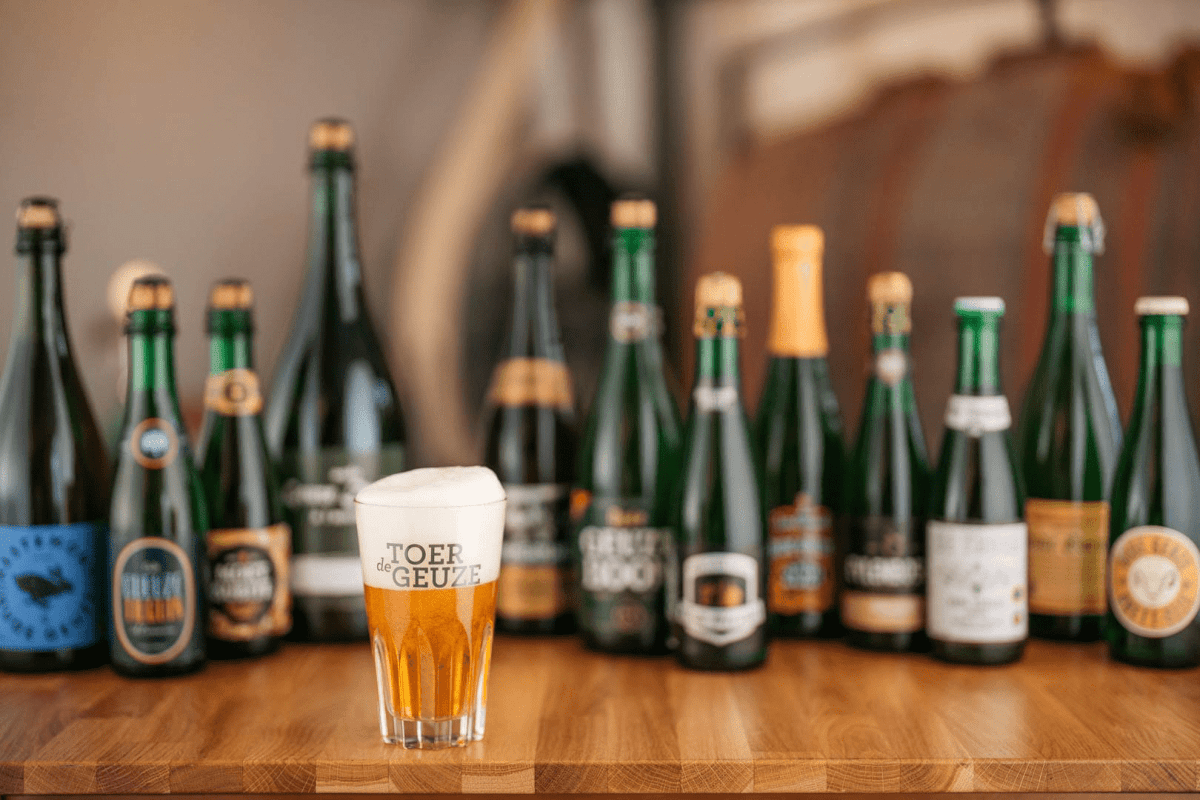
Brussels is the sole place this Geuze can be made: the city's air gives it a distinct character.
Fermenthings and the practical, everyday ferment
There’s another Brussels fermentation story that’s less romantic but arguably more important: skills.
Fermentation becomes powerful when it’s normal—when it lives in kitchens, cafés, small producers, community workshops. That’s where projects like Fermenthings come in, building a bridge between craft and everyday habit: classes, starters, practical know-how, the kind of guidance that makes fermentation feel accessible instead of intimidating.
This is what sustainable food systems look like in real life: not one grand solution, but a thousand small competencies. People learning how to preserve. Small businesses creating value locally. Seasonal peaks being absorbed instead of dumped.
Chocolate: Belgium’s most famous fermented product (even if no one says it)
Belgium, and Brussels as it’s capital, is a chocolate nation, everyone knows that. What’s talked about less is that chocolate’s flavor begins with fermentation long before it becomes a bar, a truffle, a praline in a polished box.
Fresh cocoa beans don’t taste like chocolate. The transformation starts when cocoa pulp and beans ferment together: microbes consume sugars, produce heat and acids, and trigger the chemical changes that create the building blocks of chocolate aroma while reducing harsh bitterness.
Researchers and writers have been increasingly clear about how decisive those microbial communities can be—sometimes pushing a batch toward fruitiness, florals, or deeper cocoa notes.
In craft circles, experiments like “co-fermentation” are stretching chocolate’s flavor vocabulary even further, the way winemakers talk about fermentation choices shaping the final glass.
So yes, Brussels can celebrate gueuze as a local icon. But it’s also sitting in the middle of a country whose most famous export is built on the same principle: controlled chaos, guided by microbes.
Why Brussels is a natural fermentation capital
Brussels is dense. It’s multilingual. It’s culturally layered. It’s full of small businesses and communities with distinct food traditions. That’s exactly the kind of environment where fermentation thrives.
Because fermentation isn’t only about technology, it’s about networks:
networks of people sharing methods,
networks of small producers supplying neighborhoods,
networks that keep value local and cut waste at the edges.
And it dovetails neatly with the region’s ambitions around food waste, circularity, and better food governance.
The future of food will taste like microbes
A lot of “future of food” storytelling is shiny: new proteins, new factories, new patents. Fermentation is different. It’s cheap, adaptable, and deeply human. It’s also, quietly, one of the most reliable ways we have to make food systems less wasteful and more resilient—without asking everyone to eat joyless meals or wait for a miracle.
In Brussels, you can see that future already taking shape: in a glass of gueuze, in a workshop where someone learns to keep a starter alive, in the invisible fermentation that makes chocolate taste like chocolate in the first place.
The future won’t be built by a single breakthrough. It will be built the way a good culture is built: step by step, batch by batch.