

Fermenthings: The City’s Wildest Flavours
Brussels has always been a city of double lives. Grand façades, backroom energy. A capital of institutions that still makes room for the weird, the artisanal, the deliciously stubborn. If you’ve joined our fermentation tour, you’ve already felt that tension—between heritage and experimentation, between a bottle of gueuze and a jar that’s quietly fizzing on a shelf.
Which is exactly why Fermenthings belongs in the story.
Because while Brussels’ fermentation identity is often told through lambic and gueuze—wild yeast, old barrels, time as an ingredient—Fermenthings shows the other Brussels: the one building the next layer of culture. The one asking what fermentation can do for waste, for local production, for skills, for pleasure. Not as a niche hobby. As a system.
A shop, a lab, a clubhouse for microbes
Fermenthings describes itself as a place “for all things fermented”, and they mean it. The shop is open Wednesday to Sunday, with coffee, hot sauces to taste, a fermentation library to browse, and homemade ferments like kimchi to take home.
But that description “shop” doesn’t fully capture what’s really going on. Because the core idea isn’t retail. It’s access. Fermenthings runs workshops that range from vinegar and kimchi to hot sauce and kombucha, designed to turn curiosity into competence.
That’s why we love bringing people here on the tour: Fermenthings doesn’t just serve fermentation. It teaches it. It demystifies it. It makes it feel doable, and then makes it taste irresistible.
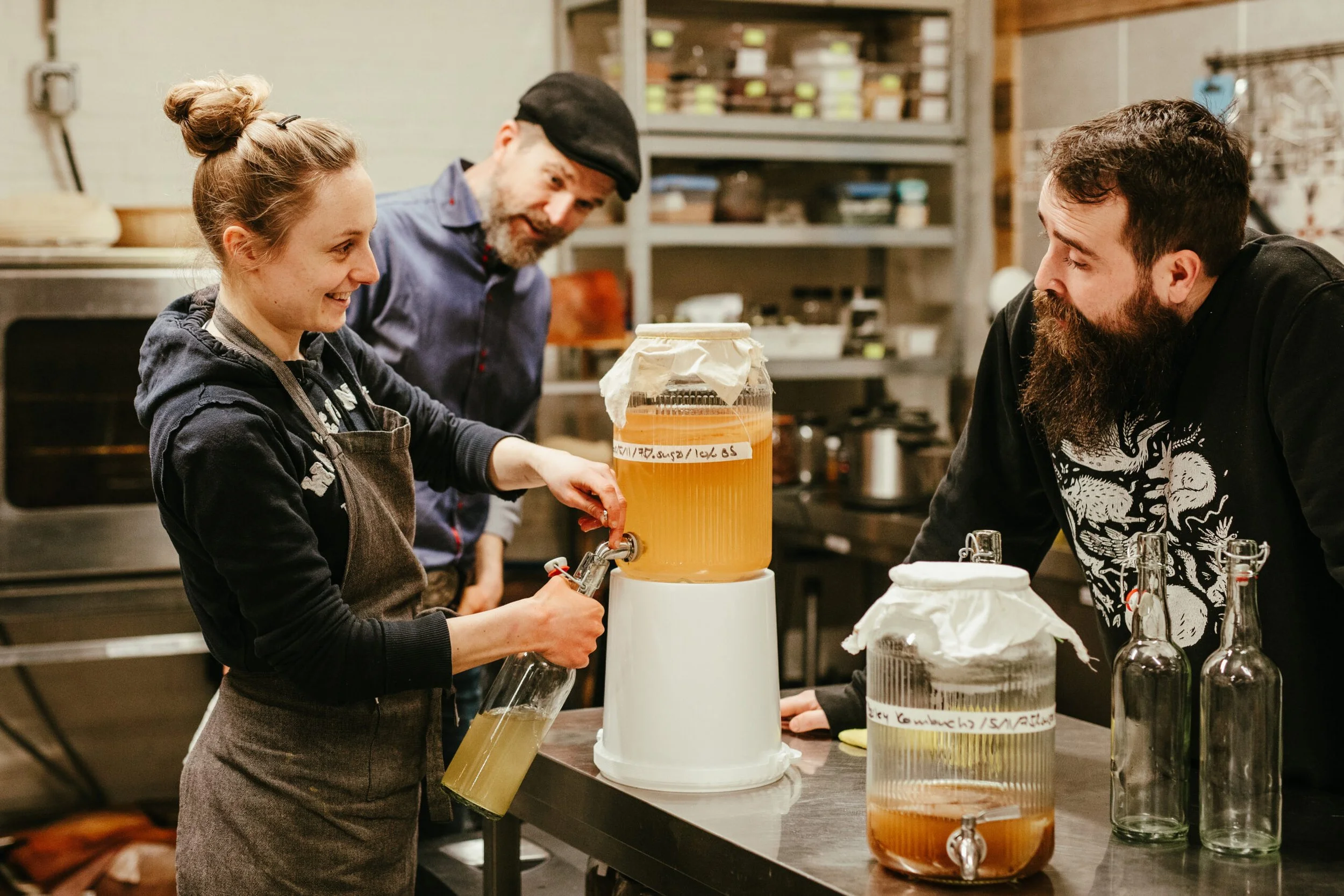
Yannick and his team at fermenthings
Yannick Schandené, and the refusal to follow a blueprint
Every story has a strong character and behind Fermenthings is Yannick Schandené. He is one of the people who helped pull fermentation out of the margins in Brussels and into everyday food culture. In a city that can be cautious about new concepts, he built something that didn’t really exist yet—what he called, bluntly, a space without a template. “There is no blueprint for a space dedicated to fermentation,” he told Brussels Beer City while describing the project’s evolution.
That line matters because it explains the whole Fermenthings energy: the willingness to build first, refine later, and keep moving as the community grows.
Fermenthings started as a shop in Jette (2017), a place for ferments from across Belgium, with workshops, tastings, and early experiments. Then came an “on tour” phase, pop-ups and events (including a noted kimchi party in Ixelles), while the team prepared the next iteration.
In May 2019, Fermenthings landed at BE-HERE, a Brussels hub for sustainable food businesses, where it collaborated with a microbrewery (La Source) and later a kombucha maker—hosting brunches, workshops, and catering across the city.
And then, like so many food projects, it had to survive the COVID era—pause, reassess, re-emerge.
From “cool ferments” to circular fermentation
What makes Fermenthings more than a lovely stop on a food lover’s weekend is the way it links fermentation to a bigger question: what can we do with what we normally waste?
Their Urban Fermentory / Lab opened at BE-HERE in September 2020 as a space dedicated to fermented food research, supported by regional funding to develop products like limonades, shoyu and miso using spent grains from beer.
That’s not marketing fluff. It’s a real-world illustration of how fermentation can help build circular food systems: taking a side-stream (spent grain) and using microbes to transform it into something shelf-stable, useful, and—crucially desirable.
The lab is also intentionally community-facing. Fermenthings frames it with FabLab-inspired thinking: sharing access to tools and logistics, and leaning into open exchange rather than closed-door “R&D theatre.”
This is the part of our tour narrative that clicks for a lot of guests: Brussels isn’t just preserving fermentation traditions, it’s upgrading them into an urban model for the future.
The Urban Fermentory era : a fermentation ecosystem under one roof
In early 2024, Fermenthings expanded again—moving within BE-HERE into a bigger space and formally becoming an Urban Fermentory with dedicated rooms for different kinds of fermentation and production. Yannick’s goal is to create a genuine living network around his production facility, which he envisions as a continuous fermentation process rather than a mere shop.
“At one time with my project fermentathing is that I got a bit stuck into a wall. We are there doing our buisness and it felt that i got a bit stuck in the process.
What we could choose is to choose like growth and unlimited growth like they say in the economy but that’s not how nature works. Nature finds its way, turn around, growns. It isn’t something that you can lock up, that you can block in one thing.
So when we developed, we said : ‘Okay, can we not use the fermentation as also the way that we create the buisness ?’ From there came out The Urban Fermentory. ” -Yannick Schandené
According to Fermenthings’ own timeline, the new setup brings together drinks projects, food transformation, koji/miso production, and sourdough bread—alongside partners like Nuu Miso, Malyce (honey wine), SCOB (non-alcoholic drinks), FELFEL (harissa), and bread cooperatives (including COOPAINS and La Source Du Pain).
That matters because it turns fermentation from a single craft into a shared platform—an ecosystem where ideas cross-pollinate, where a beverage project can feed a vinegar experiment, where “waste” becomes ingredient, and where learning is baked into the architecture.
A Human Prototype
Beyond being just a shop, Fermenthings aims to be a meeting point where the right to make mistakes is not only accepted but encouraged to faster learning. Yannick sees his role as the creator of a resilient ecosystem :
“For me The Urban Factory is a prototype. It’s also something that I want to see reused at other places in othr contexts. It’s really a human thing to do. Sometimes it even looks messy, but at the end what’s good is that it create a resilient environment to grow really cool stuff out of it.
We really want a place where people can meet, where they can share their mistakes, where they can learn, where people can really try and get their hands dirty.”-Yannick Schandené
At the end, Yannick show us a different and more human way to see the circular fermentation ; A way that’s like if we were all part of it. For him the biggest point that everybode have to know is that mistake and time make can make the food taste different, sometimes worse but sometimes even better.
In the end, Yannick shows us a more humane way to view the fermentation process one where we are all active participants in a living system. For him, time and mistakes are the very ingredients that give food its character; while they may lead to failure at times, they are often the secret to creating something even better. The goal is to learn from our mistakes, to correct from them and to share them to create more fermentation.
“Fermentation is all about time. Giving it time, it’s going to help it become better, you cannot force the processus. If you want to create the good taste, you need to give it the right time.
For us it’s a bit like when we’re waiting to the tomatoes to grow : some of them will be riper at one point, other will take more time, other will maybe be green and stay green. You can still use them in others ways ; we don’t need to be all red ripe tomatoes not at the same time but together we can find that process and make it stronger.” -Yannick Schandené
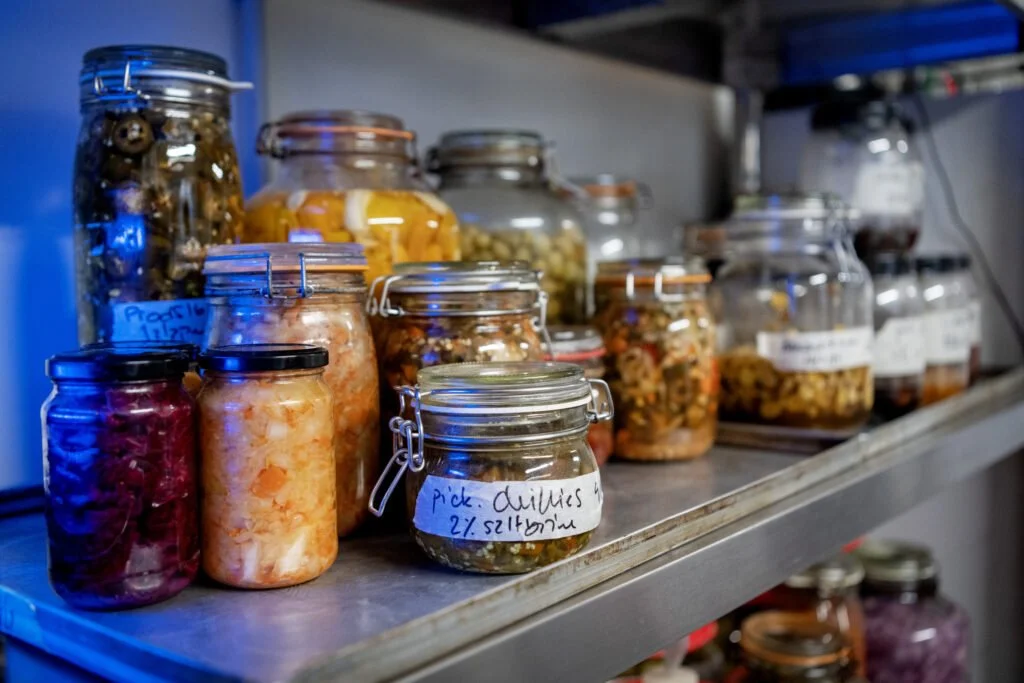
Inside fermenthings fermentation vault.
Brunch as a manifesto
If you want to understand Fermenthings in one sitting, don’t overthink it, go to brunch.
Their Exploration Brunch, hosted monthly at BE-HERE, is framed as “a discovery buffet” built from Fermenthings’ lab work and partner experiments—explicitly designed around the “future of food”: locally sourced, zero waste, low carbon, reproducible.
It’s also classic Fermenthings: serious about sustainability, not serious about being solemn. Guests, collaborations, a little bit of chaos. A reminder that the best way to sell the future is to make it delicious.
Why Fermenthings belongs on our tour
Our tour is built around a simple promise: Brussels has hidden fermentation gems—and they tell you something bigger about how food can work.
Fermenthings is one of those gems because it bridges the old Brussels fermentation story (spontaneous beer cultures, local taste traditions) with the newer one: skills, community, circular thinking, and small-scale production that can actually scale in impact.
On the tour, Fermenthings is where we step into fermentation as a living practice—where you can taste it, yes, but also understand it as a toolkit you can take home. It’s where microbes stop being a concept and start being a craft.
And Yannick, part pioneer, part connector, part relentless thinkerer—is a big reason that this exists at all: a Brussels place where fermentation isn’t boxed into one category, one cuisine, or one aesthetic. It’s allowed to be messy, global, local, and deeply Brussels at the same time.
Which is, honestly, the most Brussels thing of all.